Adding Layers to Hair
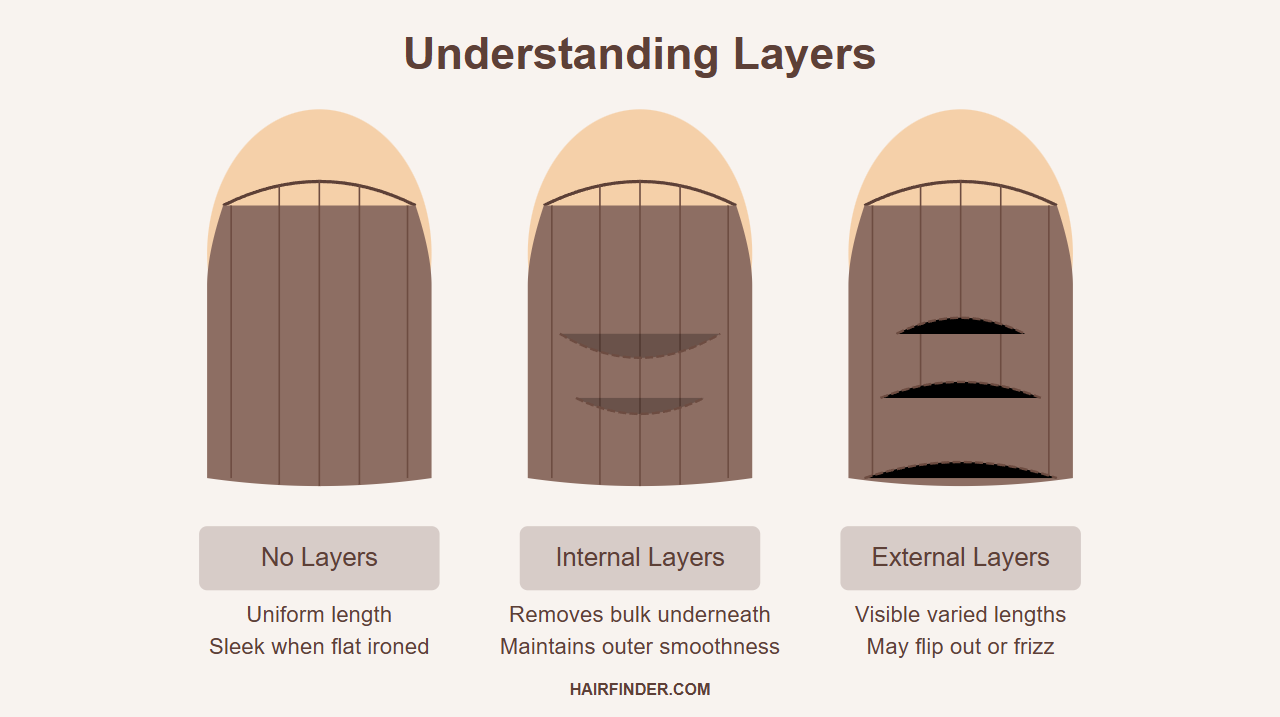
A: Adding traditional layers to your shoulder-length hair might make your styling routine more complicated rather than easier. Right now, when you flat iron your hair, you get a smooth, sleek look because all the strands are roughly the same length. Keeping the outer length relatively uniform can make it easier to achieve that shiny finish.
Layers Explained
With standard layers (external layers), your hair ends at different points all around your head. Depending on how thick your hair is, its natural wave, and how it bends, those shorter pieces might act differently than the longer sections. They can flip outward, curl inward, or demand extra styling as your day goes on. This doesn't happen with every layered haircut, but it can make maintaining a smooth, straight style more complicated.Instead of traditional layers, ask your hairstylist about getting internal layers. This cutting method removes weight from the underneath sections of your hair while leaving the top layer smooth and all one length. Internal layers can reduce overall weight and fullness. This can make your hair easier to style without changing the look of your outer hair.
Hair Products
For best results, use hair products formulated to improve smoothness and combat frizz. A moisturizing or smoothing shampoo and conditioner may help improve the feel and appearance of the hair, especially if it tends to become dry or frizzy.Rather than following a fixed washing schedule, shampoo whenever your scalp and hair feel dirty. Some people need to wash their hair frequently, while others can go longer between washes. Always apply conditioner after you shampoo, using an amount that fits your hair thickness.
You should also use a high-quality heat protectant spray whenever you style your hair. Apply it according to the product's directions before using any hot tools. If you're blow-drying and then flat ironing, check whether your heat protectant is intended for damp hair, dry hair, or both before applying it a second time.
Heat-protection products do a great job of lowering the risk of thermal damage, but they don't completely prevent damage from high temperatures. Using the lowest effective heat setting and limiting repeated passes with the flat iron can also help to reduce damage.
Consulting Your Stylist
If you are thinking about changing up your hairstyle, remember that internal layers might offer a useful way to reduce some bulk while keeping the surface of your hair looking smooth and straight. Whether they're the right choice depends on your hair's texture, density, natural movement, and how much styling you're willing to do every morning.Your stylist can give personalized advice and can also suggest a cut designed to help your hair look smoother after blow-drying, and potentially reduce how much flat ironing you need.
©Hairfinder.com
See also:
What are the pros and cons of layered hair?
What does "layered" mean to a hair stylist?
What are soft layers?