How Hair Grows

A: Hair grows from the scalp outward. The growth starts at the bottom, at the hair root inside the scalp, rather than at the visible end of the hair.
As new cells (2) form, they pack tightly together (3), harden into a tough protein called keratin, and form a hair strand (4). As new cells are continually created at the base, the dead, hardened strand is gradually pushed upward and out of the follicle. Simply put: the tips of your hair do not grow on their own. They are being pushed farther away from your head as fresh growth builds up underneath.
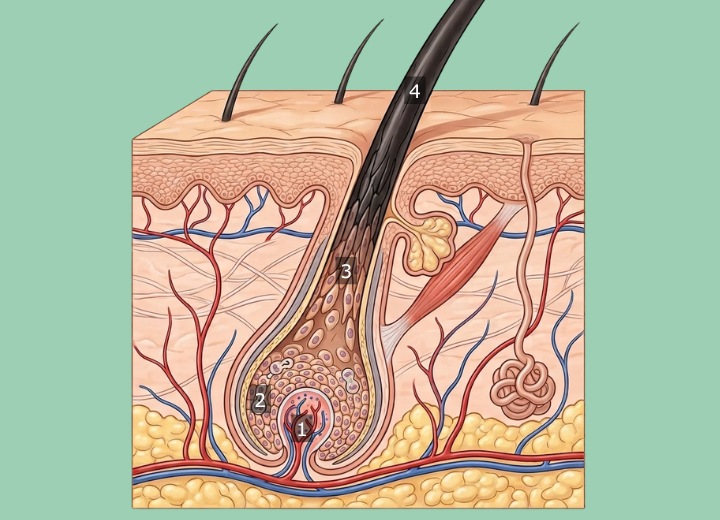
This growth process explains why hair damage is especially noticeable at the ends. The ends are the oldest part of the hair and they have suffered through months or even years of daily wear and tear. They have been exposed to brushing, friction from clothes, heat styling, coloring, chemical treatments, sunlight, and more. The newer hair near the scalp has not yet been exposed to these stresses, which is why it feels healthy and smooth while the tips are often dry and brittle.
Estimating Hair Age
You can estimate the age of your hair tips by measuring the overall length of your hair. Divide the length by 1.25 cm (or 0.5 inches), which is an average for monthly hair growth.Formula: Length / 1.25 cm = Age in months
For example: If your hair is 25 cm (about 10 inches) long, the tips at the ends are about 20 months old. Keep in mind that individual growth rates vary based on genetics, age, health, diet, and hormone levels. So, this calculation is an estimate.
Hair Growth Cycle
Hair does not grow endlessly without stopping. Instead, every single hair follicle repeats a four-stage cycle:1. Anagen (Growth phase): Lasts roughly 2 to 7 years, during which hair actively grows.
2. Catagen (Transition phase): Lasts about 2 to 3 weeks, where growth stops and the hair detaches from its blood supply.
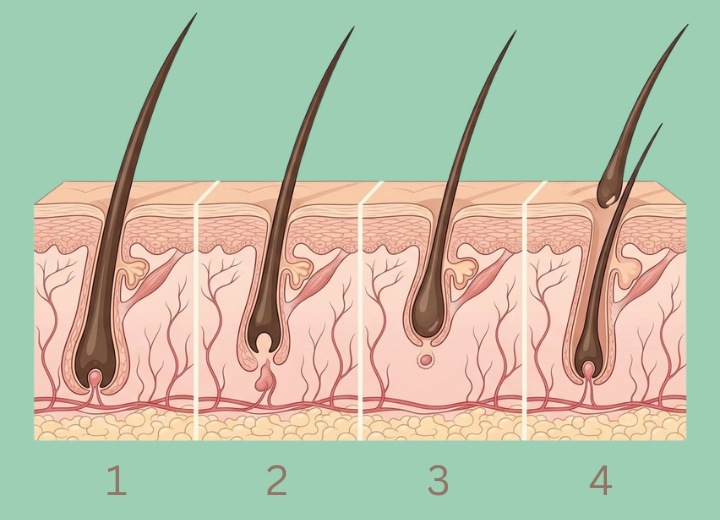
3. Telogen (Resting phase): Lasts 2 to 4 months, where the old strand rests while a new hair starts forming underneath.
4. Exogen (Shedding phase): The old hair falls out, making space for a new hair.
©Hairfinder.com
See also:
What exactly is hair made of and how does it grow?
Does a man's hair grow faster than women's hair?