Men's Hair Growth

A: On average, men’s and women’s hair grows at about the same rate: approximately ½ inch (1.25 cm) per month, or around 6 inches (15 cm) per year. While there can be small individual differences, scalp hair growth rates during the active growth phase are essentially identical between men and women.
Because of this, a month’s worth of growth makes a dramatic visual difference: adding ½ inch to hair that is already ½ inch long doubles its visible length (a 100% increase). In contrast, adding that same ½ inch to hair that is 4 inches (10 cm) or longer is much less noticeable. The hair grows at the exact same rate; it simply doesn't appear to be.
Remember that hair does not grow continuously forever. Each strand follows its own natural growth cycle, consisting of a growing phase (anagen), a transitional phase (catagen), and a resting phase (telogen). The length of the growing phase (which typically lasts between 2 to 7 years) is determined primarily by genetics.
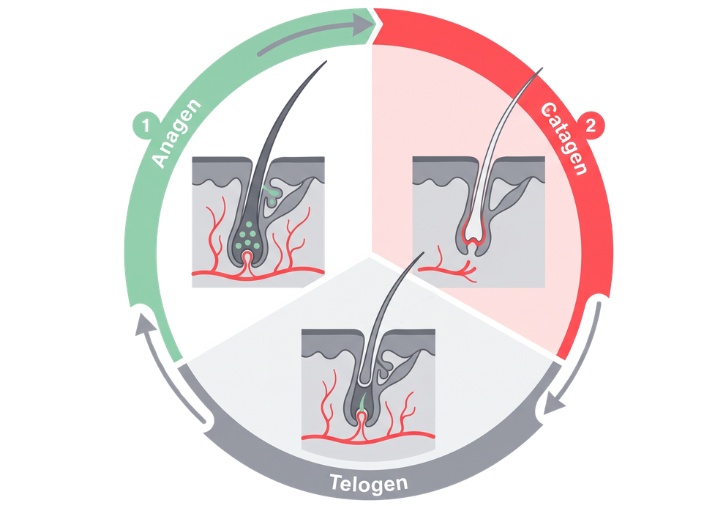
While women generally maintain a slightly longer active growth phase on average, individual genetics dictate maximum potential length. This is why some people can easily grow waist-length hair while others find that their hair seems to stop growing after reaching a certain point. In reality, the hair has simply reached the end of its growth cycle and sheds to be replaced by a new strand.
Hormones can also temporarily influence hair growth and density:
• In Women: During pregnancy, elevated estrogen levels keep more hairs in the active growth phase, resulting in thicker-looking hair. After childbirth, hormone levels drop, triggering a synchronized shedding phase known as postpartum telogen effluvium. This temporary hair loss usually resolves over time.
• In Men: Androgens (specifically testosterone and its byproduct, dihydrotestosterone or DHT) stimulate the growth of facial and body hair. However, in men who are genetically predisposed, DHT binds to sensitive hair follicles on the scalp, causing them to shrink over time (male pattern baldness). As a result, a man may notice a thickening beard while simultaneously experiencing thinning scalp hair.
©Hairfinder.com
See also:
Does different people's hair grow at different speeds?
Does short hair grow faster than long hair?
Is it true that the pregnancy pill will make your hair grow faster?