Flat Iron & Lost Natural Curls

A: When natural curls don't bounce back after washing, it is a clear sign of heat damage. And yes, using a ceramic flat iron at too high a temperature is very often the cause.
Understanding Heat Damage
Under normal circumstances, water breaks the temporary hydrogen bonds formed during straightening. This allows your hair to revert to its natural shape. However, extreme heat permanently changes and breaks the deeper disulfide and protein bonds inside the hair shaft. This destroys the built-in “memory” that gives your curls their natural shape and elasticity.If your hair has been heat-damaged, you'll likely notice several telltale signs beyond just a lost curl pattern. These signs include unusual dryness, persistent frizz, brittle strands that snap easily, and a strange spongy texture when your hair is wet. The hair might also feel rougher, look duller, and split easily at the ends.
A single session with a flat iron does not always cause a complete loss of your curl pattern, unless the heat was extremely high (above 400°F / 200°C). However, heat damage builds up over time. Multiple straightening sessions over time, especially without adequate heat protection or proper technique, gradually weaken your hair's internal structure. Eventually, it reaches a tipping point where the curls won't return.
Repairing Damaged Hair
Unfortunately, once the internal protein bonds are permanently damaged, there is no magic solution to repair heat-damaged hair. Damaged sections will not revert to their original virgin state. The most effective long-term solution is to gradually trim away the damaged ends while letting new, healthy hair grow in at the roots.In the meantime, there are several approaches to care for your hair and potentially coax some bounce back into partially damaged sections:
• Incorporate Molecular Bond Builders: Before relying only on standard deep conditioners, treat your hair with specialized bond-repair treatments (containing ingredients like bis-aminopropyl diglycol dimaleate or patented repair peptides). Unlike basic conditioners that just coat the outside of the hair, bond builders penetrate deeper to reconnect broken disulfide bonds and can noticeably revive loosened curls.
• Deep Conditioning & Protein-Moisture Balance: Heat-damaged hair becomes high-porosity and loses moisture quickly. Use weekly deep conditioning treatments that offer a healthy balance of both protein and hydration to strengthen the hair and restore elasticity. Look for ingredients like hydrolyzed keratin, silk proteins, shea butter, and natural oils. Be careful to maintain a good balance: too much protein can make hair feel stiff, while too much moisture without protein can leave it weak and gummy.
• Curl-Enhancing & Heatless Styling Techniques: Even though products cannot undo physical damage, curl creams, mousses, and gels can help define and hold whatever natural wave or curl you have left. Apply these products to soaking wet hair and gently scrunch upward toward your scalp. To blend straight, damaged ends with your roots while your hair grows out, try heatless setting methods.
• Diffuse on Cool or Low: Avoid air-drying if the weight of wet hair pulls down and stretches out your fragile curl pattern, but stay away from hot air. Attach a diffuser to your hair dryer and set it strictly to cool or low heat to gently lift and dry your curls without adding more heat strain.
How to Protect Your Hair in the Future
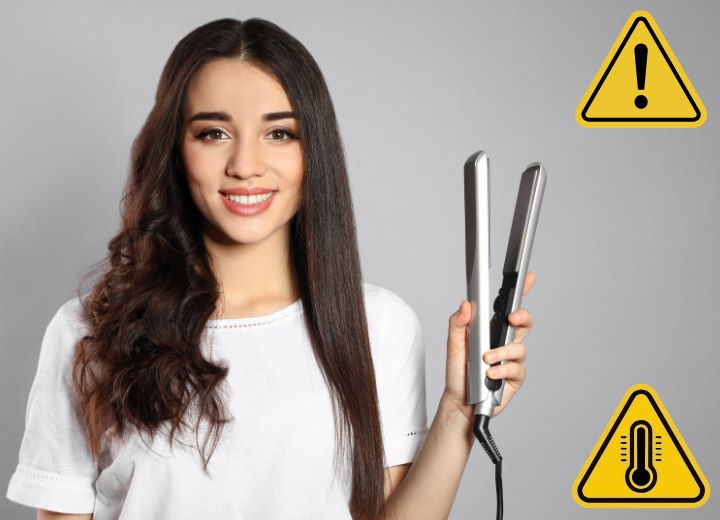
Preventing future heat damage is important for keeping your natural curls healthy and bouncy. If you choose to use heat on your hair again in the future, follow these fundamental habits to minimize harm:• Use a Quality Heat Protectant: Always apply a heat protectant before using any hot styling tools. Keep in mind that heat protectants reduce damage (usually by about 50% to 70%). They do not make your hair completely immune to extreme heat.
• Master Safe Technique: Avoid gliding the flat iron down the same section of hair over and over again. A single, slow, steady pass at a lower temperature (ideally under 350°F / 175°C for fine or medium hair, and under 380°F / 190°C for thick or coarse hair) is far less damaging than making multiple fast passes over the same section. Always use a fine-tooth heat-resistant comb in front of the iron to tension the hair so you only need one pass.
Patience is key when recovering from heat damage. Your hair grows approximately half an inch (1.25 cm) per month, so giving yourself time to transition to healthy new growth will bring the best results in the end. With consistent bond-repair steps, proper hydration, and protection against further damage, you'll be on your way back to enjoying your beautiful natural curls again.
©Hairfinder.com
See also:
Flat iron styling
How to recognize damaged hair