Spike-Up Hair

A: When dealing with men's super-short haircuts, the hair naturally goes through a brief phase where it stands up on its own. This stage is determined primarily by your hair's texture, density, and follicle growth angle.
The length at which hair naturally stands up varies from person to person. For some men, hair may begin to spike immediately after a fresh buzz cut, while others only experience this effect for a brief window before gravity takes over.
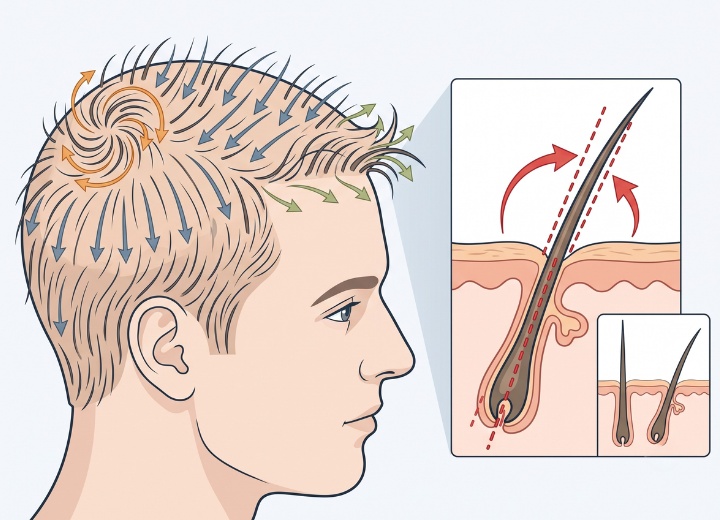
Once your hair grows past the threshold where it supports itself, achieving a spiked look requires product and styling technique. You cannot permanently train your hair to grow upward, as growth direction is genetically hardwired by your follicles beneath the scalp.
Hair Product Selection
• Fine Hair: Stick to lightweight mousses, sea-salt sprays, or light-hold styling products. Heavy waxes, pastes, and thick gels add too much mass, weighing the hair shaft down.• Coarse & Thick Hair: Use high-hold matte clays, pastes, or firm pomades. Denser hair requires higher-viscosity products to group the thick strands together and lock them upright. Matte products provide a natural finish, while traditional gels offer a shinier, firmer hold.
Styling & Heat Technique
The way you dry your hair makes a massive difference. Applying a light pre-styling product to damp hair and directing the front upward with your fingers while blow-drying on medium heat temporarily breaks and resets your hair's hydrogen bonds into an upright shape. Once dry, apply a small amount of your finishing product to lock the style in place.Growth Patterns & Follicle Angles
The final factor is the natural direction of your hair shaft as it emerges from the follicle. Scalps feature varying growth patterns, cowlicks, and angles, especially along the front hairline. Hair that naturally grows forward or flat will require more heat styling to spike up than hair that naturally emerges at an upward angle.©Hairfinder.com
See also:
How to analyze your hair
How do I figure out how the hair grows on the crown of my head?
Will I be able to achieve a spiky look with my fine hair?