Facial Hair Growth Rate

A: On average, beard and facial hair - including the mustache, sideburns, and neck - grows at a rate of approximately 0.3 to 0.5 inches (0.8 to 1.3 cm) per month, or about 0.3 to 0.4 mm per day. However, eyebrows are a distinct exception: they grow significantly slower, averaging around 0.15 to 0.2 inches (0.4 to 0.5 cm) per month (roughly 0.14 to 0.16 mm per day), which is about half the speed of beard hair.
Shaving Optical Illusion
Some people think that shaving makes facial hair grow back faster or thicker, but that is an optical illusion created by cutting close to the skin. Because the hair shaft is sliced cleanly at the surface, it leaves a blunt edge.Even a single day's worth of growth (about 0.3 mm) emerges feeling coarse to the touch and appearing dark against the skin. Hair on other parts of the body is often longer, tapered, and less closely monitored, making its daily progress much less noticeable.
Hormones and Genetics
Individual growth rates vary based on genetics, age, hormone levels, overall health, and nutrition.Men with higher sensitivity to androgens - specifically testosterone and dihydrotestosterone (DHT) - often develop thicker and fuller facial hair as dormant vellus follicles transition into terminal hairs. However, these hormones primarily drive density, coverage, and hair thickness rather than significantly increasing the speed at which individual hairs elongate.
Maximum Hair Lengths
Growth rates alone do not mean hair anywhere on your face will grow to unlimited lengths. The hair on the face, head, and body is governed by genetic factors that determine maximum length, texture, growth cycles, and overall patterns.Every hair follicle follows three main cycle phases:
1. Anagen (Active Growth): The phase where cells divide rapidly to build the hair shaft.
2. Catagen (Transition): Growth stops, and the follicle detaches from its blood supply.
3. Telogen (Resting & Shedding): The hair sits dormant before falling out to make room for a new hair.
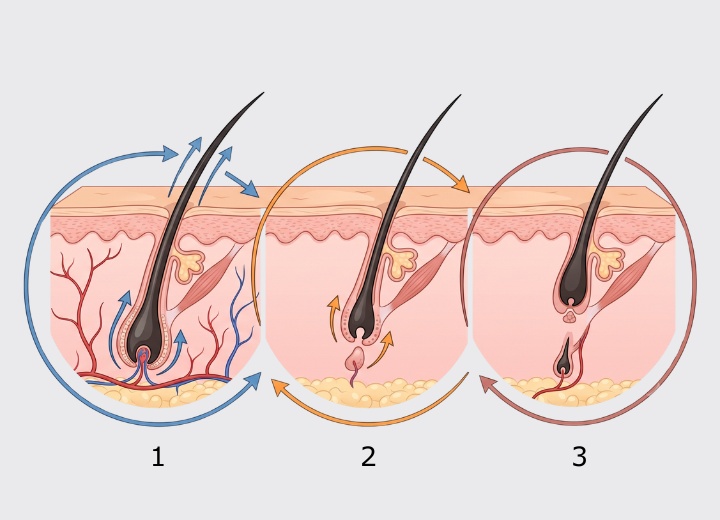
Facial hair has a vastly different active growth cycle than scalp hair or eyebrows. Beard hair typically remains in the anagen phase for 2 to 4 years (though up to 6 years is possible in exceptional cases), whereas scalp hair stays in anagen for 2 to 7 years.
In contrast, eyebrow hair has an anagen phase of only 30 to 45 days, which is why eyebrows shed before ever growing into dramatic, long strands.
Density Differences
Different areas of the face may appear to grow at different speeds due to variations in density, hair shaft thickness, and the angle at which the hair emerges from the skin.For instance, the mustache and chin often appear to fill in more quickly than the cheeks due to higher follicle density, while the neck may seem to require more frequent maintenance because the hair grows in multiple, irregular directions.
Beard Growth Changes with Age
It is common for facial hair to become fuller and more evenly distributed with age. Many men notice that their beard continues to mature well into their late twenties or thirties as androgen sensitivity continues to convert dormant vellus follicles into terminal hairs over time.©hairfinder.com
See also:
Hair growth Q&A
The average rate of hair growth
How do you grow a moustache?