De-coloring Hair

A: Whether de-coloring your hair and then going blonde will damage your hair depends on several factors, including the current condition of your hair, how many times it has been colored in the past, and how much lightening is required to achieve your desired shade.
The healthier your hair is to begin with, the better it will tolerate the process. However, going from black to blonde is one of the most dramatic color changes you can make, so de-coloring should be approached carefully.
How De-colorers Work
Most permanent hair de-coloring products are reasonably safe for hair that is in good condition, but they are still powerful chemical products. Their job is to shrink and remove artificial pigment from the hair, and that process can leave the hair feeling dry, porous, and rough.While de-coloring is generally less damaging than bleaching, it doesn't always remove every trace of black dye. Especially if your hair has been colored multiple times. In some cases, several de-coloring sessions or additional gradual lightening may be necessary.
It is important to understand that de-coloring black dye does not automatically leave you with blonde hair. Instead, your hair will turn shades of red, orange, copper, or a flat warm beige, depending on the type of dye previously used and your hair's natural underlying pigment. This intermediate warm shade usually requires additional lifting, bleaching, or cool-toned corrective processing to achieve a natural-looking blonde.
For that reason, it isn't a good idea to immediately follow a de-coloring session with a high-lift blonde color or another aggressive bleaching process. Doing too much chemical processing in a single session greatly increases the risk of severe dryness, breakage, and loss of elasticity.
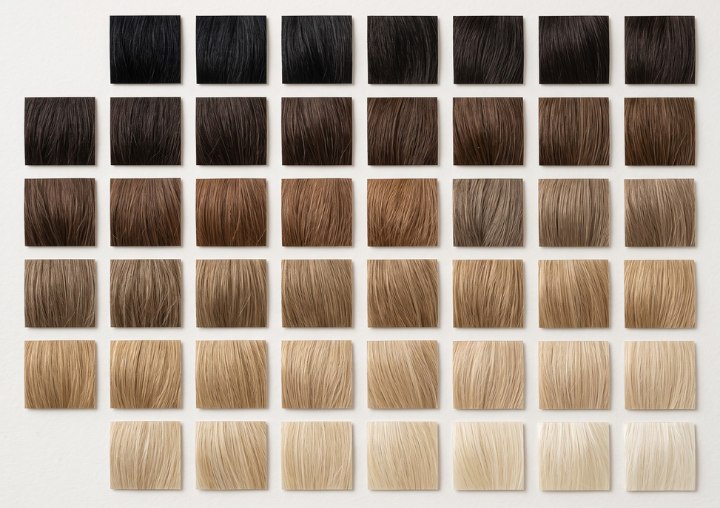
Selecting the Right Shade
If your goal is to become blonde while keeping your hair as healthy as possible, choose a dark blonde shade rather than trying to achieve a very pale or platinum blonde right away. A dark blonde is more forgiving, requires less secondary lightening, and tends to look more natural on hair that has recently been through a de-coloring process.Since your skin is very fair, you will also want to think about the tone of your blonde. Fair complexions often look best with neutral, beige, or cool ash blondes, especially if you have pink or rosy undertones, as these balance out flushness in the skin.
The key throughout the de-coloring process is to avoid over-processing your hair. The lighter you try to make your hair, the greater the potential for damage. Leave at least several days - preferably a week or more - between major chemical processes. During that time, use a bond-repairing treatment, deep-conditioning hair masks, minimize heat styling, and avoid shampoos with harsh sulfates.
See a Professional
Given the immense chemical risk of lifting black dye to blonde, you should not attempt de-coloring your hair at home. Removing dark synthetic pigment is a complex process. Doing this yourself carries a high risk of uneven, blotchy patches, severe chemical breakage, and severe damage.To protect your hair, strongly consider booking a consultation at a salon instead. Experienced colorists have access to professional-grade bond builders, custom-mixed lighteners, and tone correctors. They will monitor your hair in real-time, safely manage underlying warmth, and formulate a controlled, multi-step roadmap to get you to your target blonde safely.
©Hairfinder.com
See also:
How to color your hair
Ways to ruin good hair
How decolorizing hair with bleach works