Hair Swirls and Handedness

A: No, that is a myth. Some studies have reported a weak statistical link between scalp hair swirl direction and handedness, but the relationship is neither strong nor reliable enough to predict whether a child will be right-handed or left-handed.
This misconception gained popularity in 2003 when a geneticist at the U.S. National Cancer Institute published research suggesting that a single dominant gene specified both right-handedness and a clockwise hair swirl, while a recessive version allowed both traits to be determined completely by chance. Under that model, non-clockwise whorls were expected to appear in roughly half of all left-handed people.
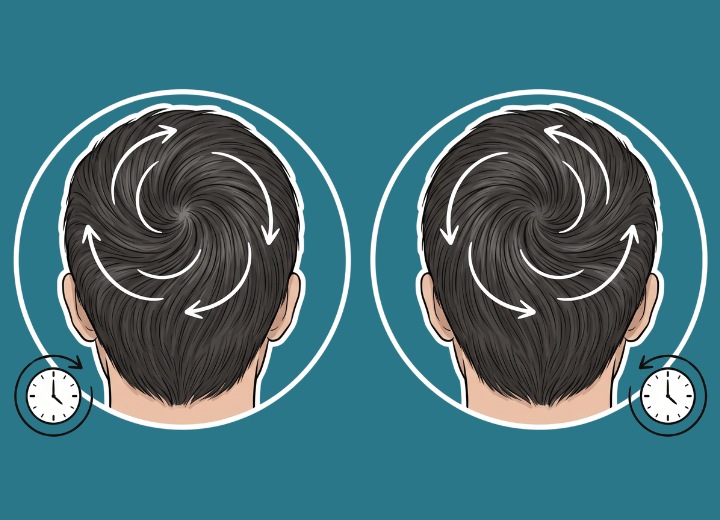
Follow-up research, however, has disproven that single-gene theory:
• Handedness is controlled by many genes, not one: Large genome-wide association studies show that handedness is a complex trait, influenced by hundreds of subtle genetic variants rather than a single master genetic switch.
• The real-world numbers don't match: Population surveys show that counterclockwise whorls appear in only about 10% to 20% of left-handed people and roughly 8% to 15% of right-handed people. The difference is too small to use as a reliable indicator.
• Twin studies disprove a strict genetic link: Identical twins share 100% of their DNA, yet they frequently have different hair whorl directions and opposite hand preferences.
The direction of a hair whorl is shaped by physical skin tension as the head expands, while hand dominance is driven by how the left and right halves of the brain develop. Left-handed people do not always have counter-clockwise hair whorls, and clockwise hair does not guarantee right-handedness. So your baby's hair swirl can't tell you which hand he or she will prefer.
©Hairfinder.com
See also:
Hereditary hair color
Can twins have different hair colors?