Changing Hair
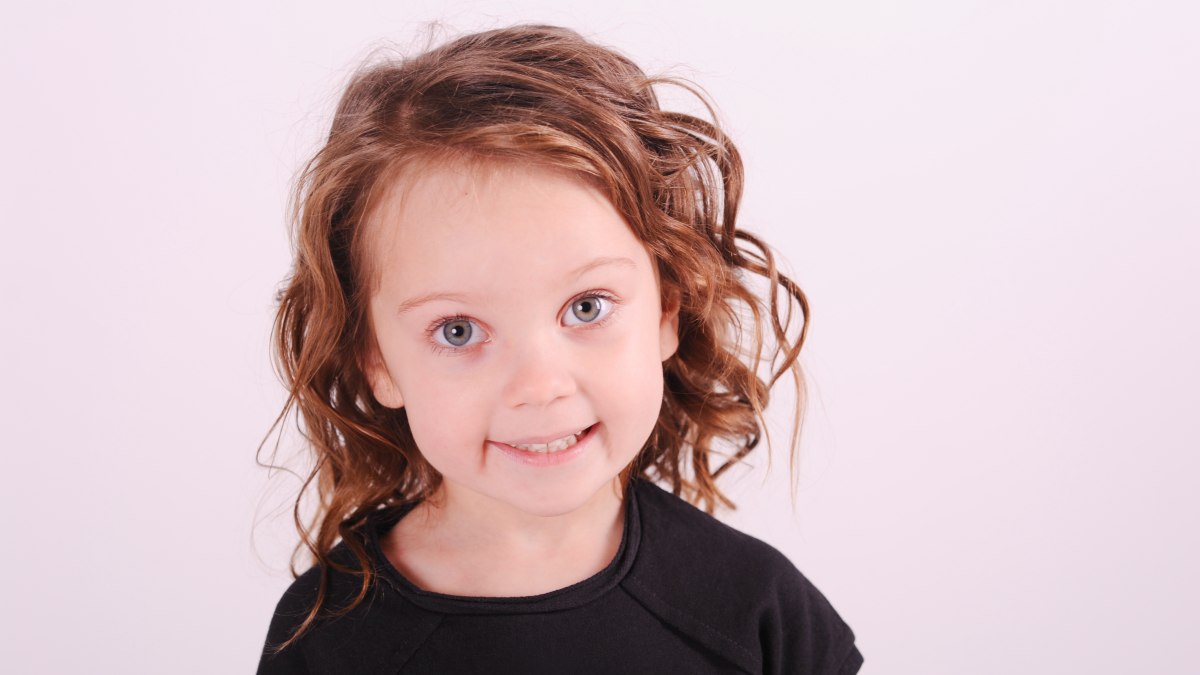
A: Yes, it is possible and very common. As children grow, their bodies develop according to their unique genetic blueprint, and their hair is no exception. A child who has fine, wispy hair at age two may have a much thicker, fuller head of hair by the time they're five or six. In the same way, the curl pattern of hair can gradually change throughout early childhood.
Changing Follicles & Strands
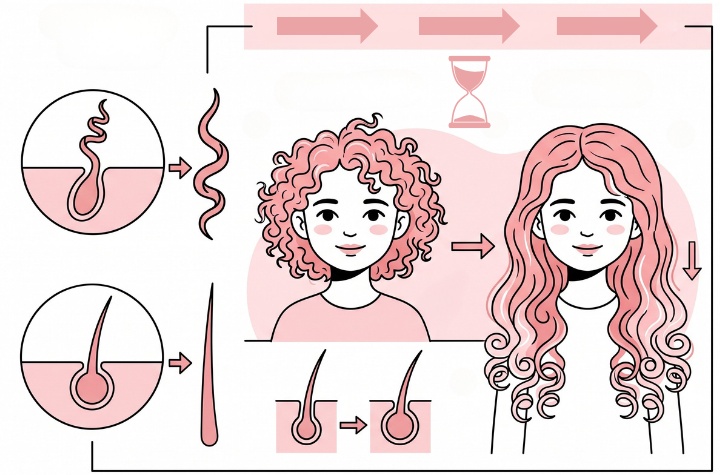
It's very common to see a child's curls become looser during the preschool and elementary school years. Hair follicles (the tiny structures beneath the scalp that act as the molds for each strand) continue to mature and change shape as a child develops. Symmetrical, round follicles grow straight hair, while asymmetrical, flat, or oval-shaped follicles produce waves and curls. As your granddaughter grows, her follicles are physically changing shape.Additionally, infants are born with fine vellus hair that eventually gives way to full terminal hair. As mature terminal strands grow in, they are typically thicker in diameter. Sometimes, when a strand gets thicker, a loose ringlet turns into a gentle wave simply because the strand has more structural rigidity.
The length and weight of the hair also play a role. Curly hair naturally springs upward when it's short, but as it grows longer, gravity pulls down on each strand. This extra weight stretches the curl, making it appear flatter or wavier near the scalp while the lighter, older ends hold onto those original tight spirals.
The Haircut Myth
To give an example, my cousin had a head full of silky ringlets when she was a baby and toddler. My grandmother advised my aunt to keep her hair trimmed - especially the longer, straighter pieces that began to appear. She firmly believed that trimming away the straighter hair would save the curls.Of course, that's not how hair works. Haircuts only alter the dead fiber existing outside the scalp. They don't change the biological shape of the hair follicle underneath. As my cousin grew, her hair follicle shape shifted, the strands grew thicker, and the additional weight stretched out the curl. By the time she started first grade, her hair was wavier than curly. Today, as an adult, she has a beautiful head of soft waves.
What's Happening to Your Granddaughter's Hair
Your granddaughter's hair sounds very much like it's going through this natural transition. The spirals at the ends are likely the older hair from when her follicles were smaller and shaped differently, while the newer growth closer to the scalp reflects her maturing hair structure and the extra weight pulling it down.Children's hair often continues to evolve throughout childhood and into adolescence. Major biological shifts - especially the surge of hormones during puberty - can alter follicle shape and oil production, sometimes turning straight hair curly or vice versa. While there's no way to predict exactly what her hair will look like as an adult, what you're seeing now is a perfectly normal and fascinating part of growing up.
©Hairfinder.com
See also:
Hair growth Q&A
Hair wave pattern
Change in hair texture because of genetics, environment or products