How to Cut a Fringe (2)
Previous page
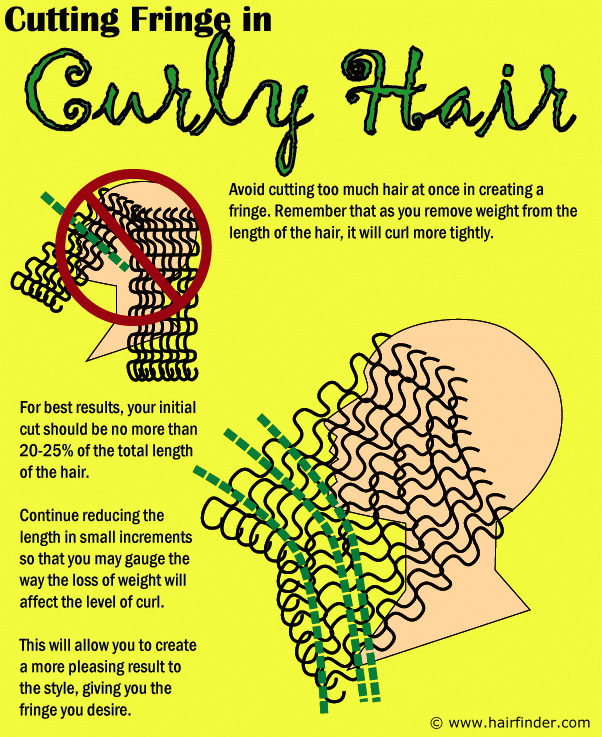
As long as the curl is exposed to this level of weight, the hair will appear to be relaxed and wavy, but if you remove even a small portion of the length (and therefore the weight) the hair’s natural elasticity causes it to assume a curlier configuration. Because of this, any attempt to create a fringe in very curly hair should be approached carefully.
Solutions:
With curly hair, in order to create a fringe look, you want to make sure that the fringe is kept much longer than you initially think necessary. Remember, you can always take off more length in a few seconds, but getting it back takes months. Your initial cut of the bangs should not involve shortening the hair by more than 20-25% of its total length.
Doing this will help you avoid unfortunate results and look your best while giving you the fringe look you want.

Of course, very curly hair isn’t the only type that can be problematic when it comes to creating a fringe hairstyle. Even when the hair is stick straight, if it is very coarse (having a thick diameter) removing weight from the hair will make it more likely to stand out rather than bend over and lie in the way you might want.
Therefore, just as with curly hair types, you must consider the amount of length being removed carefully so that the hair will hang as opposed to hovering above the forehead like the brim of a cap.
Solutions:
In the case of coarse and straight hair, the key is also to remove the length in very small increments. You want to leave enough length so that the weight of the hair will overcome the hair's rigidity. Sometimes, the added weight of various styling products can help make the hair lie in the direction you desire, but it’s best to use these to enhance a look rather than create one when it comes to bangs.
It's also important to remember not to over-texturize the fringe in coarse and straight hair types. The process of texturizing the hair will shorten the length of some of the hairs and can make the resulting fringe appear frayed and disheveled, rather than soft and alluring (which is generally the goal).
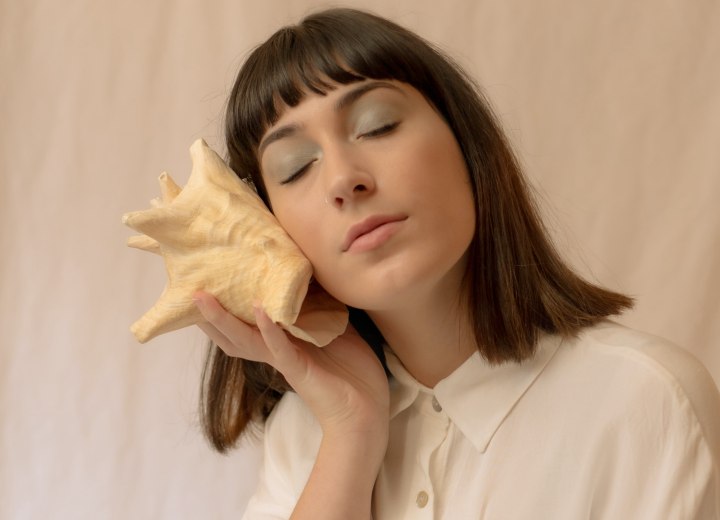
Fine hair has its own issues in that it will often behave in the opposite way of its coarser counterparts. Nothing is more frustrating than wanting to have a softly curving fringe to drape over the forehead and ending up with a fringe that simply hangs limply against the face and easily becomes stringy-looking.
The reason this happens is that fine hair (hair with a small diameter) cannot support as much weight as coarser hair, and therefore is more susceptible to the weight imposed by the length of the hair. You can sometimes bolster fine hair by using a volumizing shampoo and conditioner or a styling product that creates lift and volume at the scalp, but – once again – it is always best to use styling products to enhance a look rather than to create one.
Continue reading ...