Dealing with Hair Damage (2)

Often, people who wear ponytails report that their hair is no longer growing, when in fact it is repeatedly broken at the same distance from the scalp due to the trauma caused by the tight rubber band. Rather than using rubber bands for ponytails, fabric scrunchies, which loosely hold the hair together, are the preferred choice.
Know Your Hair
Curly hair tends to break more easily than straight hair. For this reason, the texture of the hair can determine how aggressively hair can be styled. African Americans, for example, typically have a kinky hair wave pattern with a coarse texture that should be gently groomed with a wide-toothed comb or hair pick.
Do Your Scissors Make The Cut?
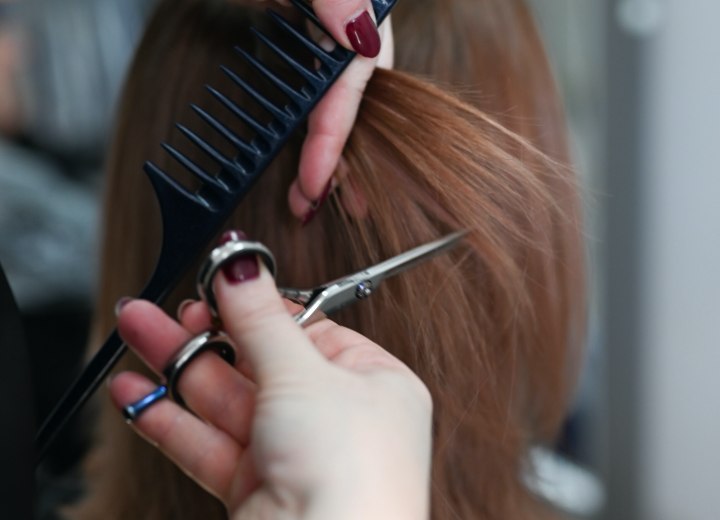
The hair should always be cut with sharp scissors, as any defect in the scissor blade will crush and damage the hair shaft. Crushing the ends of the hair predisposes it to split ends.
If you regularly cut or trim your own hair, invest in a pair of scissors specifically for this purpose. Look for scissors that fit comfortably in your hand. The cutting blades of the scissors should be shorter in length than your fingers. This allows you to have better control over the hair and the cut being made.
Do not ever allow your "haircutting scissors" to be used to cut other things, such as cloth or paper. Keeping the scissors reserved for their specific tasks makes it so that they need to be sharpened less frequently.
Even though many salon owners would disagree, there is no hairstyle or procedure that can reverse hair damage. Hair is essentially a textile - it looks the best when new and degrades with age and use. In general, the less that is done to the hair, the healthier it will be.
Hair styling products can help improve the cosmetic appearance of the hair, but should always leave it flexible. Stiff styling products that promise a long-lasting hold can actually cause hair breakage when trying to restyle the hair with combing.
Avoid Excessive Hair Color and Bleaching
Hair coloring and bleaching are universally damaging to hair. It is sometimes said that chemical processing adds volume to the hair. This means that the dyeing procedure allows the hair to stand away from the scalp with greater ease. This is not due to healthier hair, but rather to hair damage that makes the hair frizzy and more susceptible to static electricity.
The basic rules of hair dyeing are always staying within your color group, preferably dyeing the hair no more than three shades lighter or darker than the natural color. Remember that the chemical process of lightening the hair involves dispersing color molecules from the hair shaft to remove existing color. This also removes some structural stability elements in the hair. The more you lighten the hair, the more damage is done.
Making Waves with Hair Texture
Hair relaxing and permanent waving are two procedures that can be damaging to hair and should only be used sparingly. While hair relaxing can weaken hair, it also can actually facilitate hair growth in people with kinky hair since the hair is less likely to break when combed. The relaxing process straightens the hair and makes it easier to groom. However, the grooming should be done gently to avoid hair breakage.
When using permanent waving, the curls should be as loose as possible with the interval between procedures being as long as possible. For people with damaged hair, the perming solution should be weak and left in contact with the hair for as short a period of time as possible. If you notice that your hair is becoming brittle or looking dull or damaged, you should consult your dermatologist right away to determine the cause and how to treat it.
Repairing damaged hair takes time and usually involves growing healthy hair to replace the damaged hair. The sooner you address any issue, the sooner you'll notice results.
©Hairfinder.com
See also:
How to find out if your hair is damaged
Hair masks to treat damaged hair
Myths about hair and hair care
Myths and facts about African hair