Myths and Facts about African-Ethnic Hair

Learning to identify these traits helps to see how the various stereotypes are formed, but it is the practice of actually working with hair of various ethnic types that helps one see that the stereotypes are often false.
“African hair feels harsh and scratchy.”
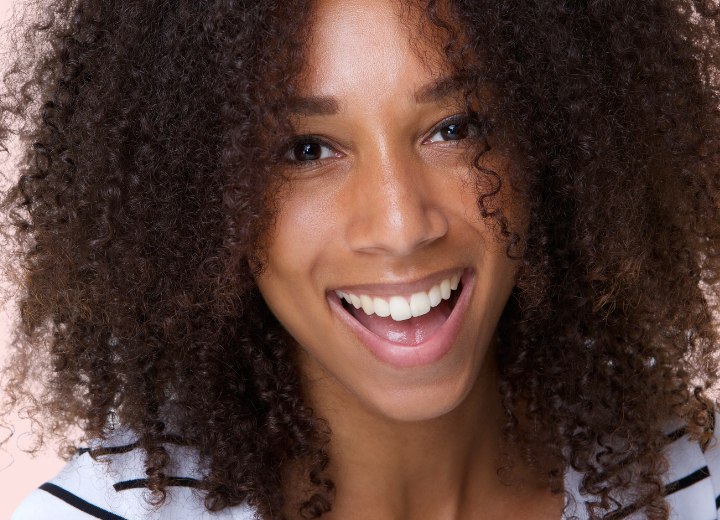
Okay, so I actually learned this was false early on. In grade school, I sat behind an African American girl who wore her hair in thick twists. One day, after asking, she let me touch her hair and I discovered that it was very soft. It was only the tightly-kinked wave pattern that made it appear that it would feel rougher.
Visual appearances can often be misleading. Hair that is very curly can look damaged, which is why we gauge the health of the hair by feel. Personally, I think the reason kinky hair became closely associated with damaged hair is a result of the "home perm" revolution of the 70s. There were so many poorly done perms and cases of damaged hair that ended up kinked and frizzy, that kinky hair caused people to be reminded of a poorly done perm.

This is completely untrue. African hair can be found in a wide range of wave patterns. I have met women and men of African descent whose hair covers a range of wave patterns, from almost straight, to smooth, tight coils. Yes, there is a larger percentage of kinky wave patterns found among African hair, but even the kinky hair varies from individual to individual.
It is only societal pressure that has led women and men of African descent to resort to chemical relaxing processes to make their hair smoother, and more like the popular images of beauty. That, and the desire to have more options for styling the hair.
“African hair is oilier/greasier than European hair. This is evidenced by the fact that water beads up on their hair.”
This is also untrue. African hair actually tends to be no more or less oily than any other ethnic group’s hair. The reason that water tends to bead up on African hair is that the hair tends to have a more compact cuticle layer, which makes the hair resistant to moisture. Water and other liquids cannot penetrate the cuticle layer as easily and therefore simply sit on the surface of the hair. This also means that resistant hair holds moisture better and is usually in better condition.
The compact cuticle also means the hair looks shinier than hair with less compact cuticle layers. The sheen can be enhanced by the oils produced by the scalp, which leads to overly shiny or oily-looking hair, since the oil will be less likely to penetrate the hair shaft.
When the hair is processed, the cuticle layer is raised, and the hair becomes more porous. The processed hair absorbs water and other liquids more easily, but also disperses them more readily as well. This is why processed hair can often become dry, brittle, and rough-feeling.
This is not only untrue, but in my experience, is completely the opposite of the truth. When it is healthy and in good condition, African hair responds beautifully to a variety of styling techniques. Natural African hair can be braided into intricate designs and patterns, and the wave pattern of the hair allows the braids to hold tightly and stay neat and orderly.
African hair can also hold a curl beautifully. I have created curly hairstyles with African hair using both wet roller sets and a curling iron. The ease with which the hair curls, and the clean, defined look of the curls, makes for some truly beautiful styles.
African hair is especially great for styling updos. The amount of body and the ease of styling allow the hair to be used to create intricate hair designs with stunning results. In fact, other hair types usually need to be treated with a significant amount of hair product in order to get the needed texture to create the kinds of hairstyles that are easily designed with African hair.
The bottom line for me is that the stereotypes and myths that have been perpetuated regarding African hair are not only frustrating, but often have malicious origins. After learning the truth firsthand, I would in many cases prefer to work with African-American hair than any other ethnic hair type.
©Hairfinder.com