1960s Hairstyles
The Beatles invaded America with their long hair and the music began to change into a sound with British accents, and Ringo Starr became a household name. The new look for rock bands was flowing tresses, but that didn't stop Chubby Checker, Jackie Wilson, or Stevie Wonder from still doing their own thing.
President John F. Kennedy and his wife Jacqueline were beloved by all; as Jackie set the trend for fashion. Most of the time, she wore her hair just below her shoulders and flipping up with a pillbox hat. She was conservatively dressed, wearing skirts that came to about an inch below her knees, paired with a matching dressed top that reached her waist. Gloves completed her classy look. Those who weren't complete rebels of that era would follow her lead and wear their hair in the stylish flip.
Beehives were seen at dances, as little ornaments of birds, bees, flowers, or jewels were placed into the hive to bedeck this extravagant hairstyle. Kim Novak brought the French twist bouffant into being as we watched her on screen, with her smoky lavender-hued blonde color. So sexy. This 1960s hairstyle was quite simple to do, if you knew how.
If you are curious, here are some easy instructions for you: After rolling the hair all under in the back and on the sides, make a small part if desired and roll the top toward one side in the direction you would like the hair to go, dry it and brush out vigorously. Section off the top, sides, and crown. Begin at the bottom and backcomb the hair until most of it is close to the head. The proper way to backcomb is to take about an inch of hair while using your rattail comb. Hold the very top of this section and slide your comb on top, pushing gently down toward your scalp.
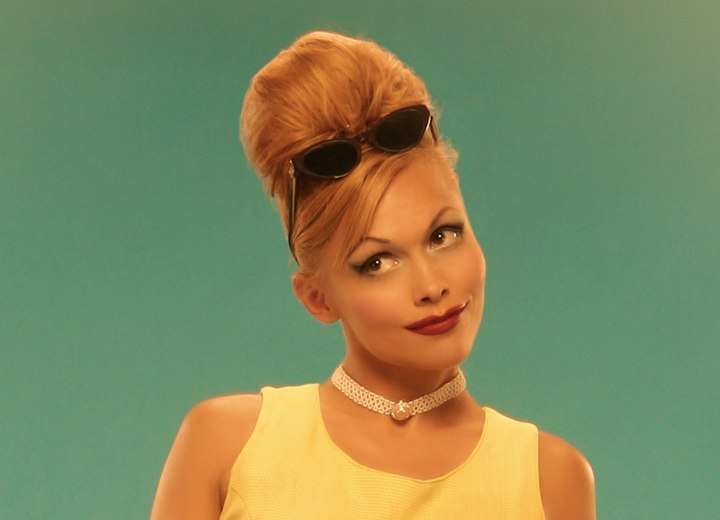
Now, you have all of the crown to do something with and you are going to begin taking one-inch sections and backcombing just like you did the previous section. After you are finished, take one layer at a time, smoothing it over with your brush, and begin placing it over about one-half to two inches of the French twist. The amount you decide to cover is a matter of personal preference. This also depends on the length of the hair. Shorter hair will be more like a bubble (like Kim's), longer hair will be like a large roll. Fasten with hairpins. Follow this through as you lay each section on top of the other.
When the hair is extra long, you can fashion a large roll and secure around the twist with pins. Take the sides and backcomb the same way, smooth out and turn the hair under making a roll as you place in back to lay on the twist or above and secure with pins. Backcomb the top, smooth it into the direction it has been rolled into, hopefully creating a wave. Lift with a rattail comb or a large hairpin for added height.
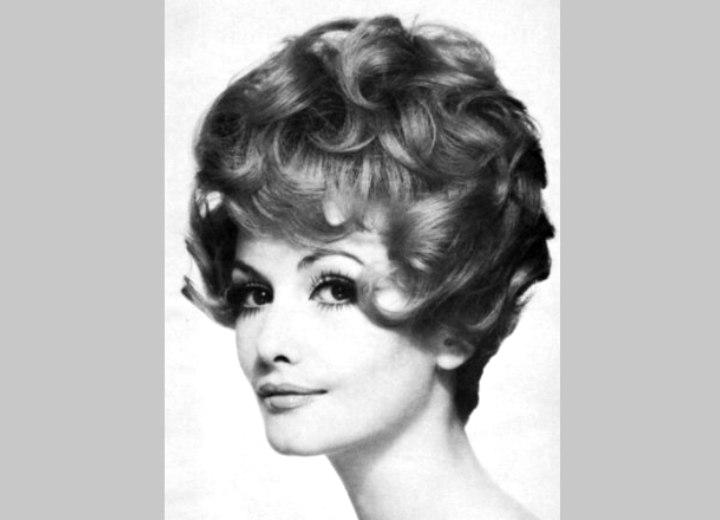
That is just one hairstyle that was so prominent during the 1960s, and there are so many more. With the bubble, strong backcombing had to be done to get that rounded effect, and then some would use a comb, others a brush, and still others would use a large hairpin to gently bring each layer over the other lightly to maintain the volume they created. Sometimes, the sides would come toward the face in C-curls, and a bow would be placed on the top of the head between the bangs and the side of the hair that was swept back. Other times, there would be one large C-curl on each side for a dramatic effect.
Continue reading ...