How To: Long Graduated Cut
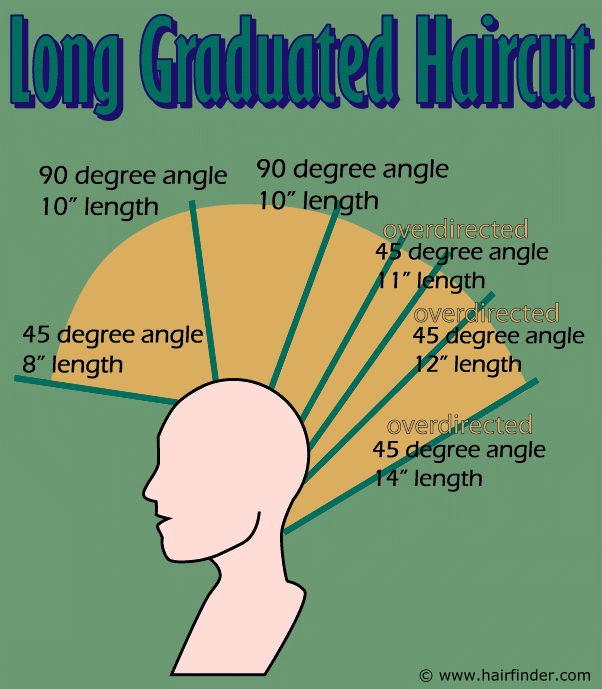
The long graduated haircut is traditionally a cut for women who want an especially long layered look. Like other haircuts, the term "long graduated cut" can encompass a wide range of specific looks, as the primary techniques of the cut involve tension in the segment being cut and the utilization of cutting angles of 45 degrees or smaller, along with overdirection.
Overdirection is the technique of elevating the hair beyond the 90-degree – or straight out from the head – position, in the direction opposite the way the hair would naturally fall. It is used to create increased layers in the interior and at the perimeter of the hair.
As it was in a short graduated haircut, the fringe will be elevated to a 45-degree angle and cut using a vertical cutting line in the long graduated cut. The top and crown sections are going to be elevated straight out from the head (at 90 degrees) and cut, and the side and nape sections will be overdirected or elevated to a reversed 45 degrees and cut with vertical cutting lines as well.
Here, the concept of a "reversed 45 degree elevation" and "overdirection" means that the hair is lifted beyond the point at which it stands straight out from the head and is held at what would be a 45-degree angle if the client were upside down. The diagram shown gives you the lengths to create a long graduated cut.
To start, you should:
1. Section the hair in a standard seven-section parting, separating the sides and top into three sections. The crown should be divided into two equal sections, roughly triangular shaped. The nape area is divided into two equal halves down the center. Click here for illustrations on sectioning the hair for cutting.
2. Determine your desired lengths for the front, back, and sides, and cut a small guide to mark this length. Cross-check your side lengths by bringing them together in either the front or back to ensure they align correctly. If the two ends meet at a central point in the front or back, then they are even. If not, bring the strands together at a central point and trim the excess length from the longer end.
3. Cut your forward sections first to allow you to re-secure the hair out of the client’s face once you are done. Use a 45-degree elevation at the fringe and forward top section, increase the elevation to 90-degrees as you move back along the head.
4. Move to the back section next and cut your perimeter length as desired. Work from the back center to the left and right and cut the perimeter as desired for the style. Cross-check your side cuts as you go to ensure balance and evenness in the cut. Be sure to raise the hair to the overdirected angle to ensure the proper layering depth.
5. Lower the sectioned hair one-half section at a time and cut it using the overdirected elevation and vertical cutting line. Work from center back to each side, alternating between slices to make sure to keep the cutting balanced. As you finish a half-section, lower more hair and repeat the process.
6. Alternatively, you can lower the hair from the top downwards and cut it in the opposite direction. Keep the overdirected elevation, but simply cut from the top of the head and work your way down to the nape. Carefully blend out and clean up the perimeter edge of the cut once you’ve completed it.
7. Once you’ve cut all of the sections of the hair, cross-check the layering by combing slices in the opposite direction in which the hair was cut. Look for pointy angles and protrusions that indicate hairs that were missed as the sections were sliced and cut. Trim these away to blend with the rest of the layers.
After the hair is cut, style it as desired. Depending on the particular lengths of such cut, the hair can be blow-dry styled and/or curled using a wet set or heated tools. The long graduated cut works especially well with large, rolling curls of hair. However, even smaller curls can make an interesting style in the longer hair.
© Hairfinder.com
See also:
Stepped haircuts
How to cut a short graduated hairstyle
How do you cut the hair into a graduation cut?
What is the difference between long graduated cuts and short graduated cuts?