Choosing Contouring Colors
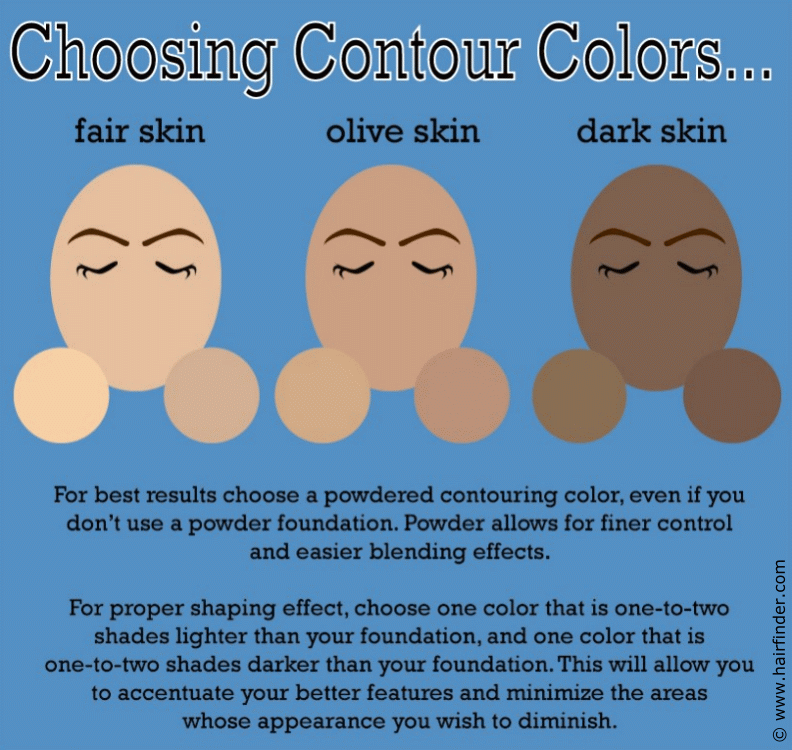
It’s time to talk about the single-most overlooked cosmetic product/technique by the average woman: contouring make-up. With the right combination of highlighting and lowlighting shades, you can adjust the look of your features in myriad ways. You can make your nose appear slimmer, your eyes deeper and your jawline softer. You can soften the look of jowls and hide the wattle beneath an aging chin. All it takes is a little practice, some patience and just the right colors for your skin type.
I’m going to break with tradition here and tell you now that there is NO need to go out and purchase make-up specifically labeled as contouring make-up. In fact, some makers are getting away from the “specifically purposed” cosmetic products and appealing to the modern shoppers’ sensibilities by marketing the products that are basically the same as multi-purpose items.
What Kind of Foundation Works Best
You can use any foundation formula for your contouring make-up, and if you have a brand and type that you absolutely cannot do without, then by all means stick with what you love. It will make it easier for you to master the contouring application techniques if you feel comfortable with the medium with which you are working.
However, it’s my opinion that the newer “mineral powder” make-up formulas are ideal for use as contouring make-up – even if you prefer to use a liquid or cream foundation. In fact using a powder make-up for contouring over a moister foundation application can actually work well for many skin types. Just remember that the goal is ultimately to create very blended looks. This won’t be possible if there’s too much moisture, so apply your foundation in smooth, thin, even coats and blend it in well.
How to Know what’s Right
In order to choose the right colors, it’s going to be necessary to go where you can “test” the make-up. Unless you are very familiar with the whole range of shades for the make-up your are working with, or you have loads of money to spend, the test is best.
This testing is doubly important if you are going to use a different formula of make-up to the kind you use as a foundation. If you plan to use the mineral powder formula and you regularly use liquid foundation, it will help you to get a feel for the way the minerals are applied and how they blend.
Find your base shade, then look at the shades one step lighter and one step darker than your base shade. Remember that your base shade should apply to the skin and become invisible. If you can see where the make-up is applied because it is lighter or darker than the skin around it, then it’s not appropriate and you need to shift to the next shade.
Once you have the proper shade for your base color, look at the shades next to it on either side. Select one shade lighter and one darker and apply them next to the test of the color that matches your skin tone. The difference between them should be subtle, but apparent when side by side. You’ll blend out the demarcation lines when you apply the contouring. In some cases, you may need to go to the shades two steps from the one you use as a base if the transition between the shades is very minute.
Once you’ve chosen the contouring colors for use with your foundation, you’re ready to master the contouring basics.
Basics of Contouring
The entire concept behind contouring is the theory of the interplay of light and dark to create depth and perspective in drawn and painted shapes in artwork. Just as an artist can take a plain, white, flat piece of paper and through the use of lighter and darker colors and shading can create an image that looks three-dimensional (even though it is still only a flat surface).
Once you apply your foundation and allow it the proper amount of time to set (using translucent powder as appropriate), you can begin trying out your contouring techniques. If there is a feature you want to enhance, such as the cheeks, apply the darker contouring shade in the hollow of the cheeks by puckering your lips and dabbing the color on the underside of the upper curve of the indention. Then apply the lighter shade lightly to the top of the cheek bone in the same manner. Afterward, use a blending brush to gently smooth away any sign of demarcation.
For more techniques on contouring, see “Contouring Tips and Tricks”.
©Hairfinder.com
See also: How to use make-up