|
 |


Hairstyles and Fashion of the 1940's
When I think of this era I think of all glamour. I’m not too far wrong as Hollywood
characterized the 1940’s as a very romantic and glamorous time with the debut of such movies as Tennessee Williams “Glass Menagerie”
and “Streetcar named Desire.” Frank Sinatra and Bing Crosby were crooning and swooning into the hearts of lovers everywhere.
Comedians Jack Benny and Bob Hope were making people laugh in their living rooms while listening to their radios. Tight sweaters
were trendy as their boyfriends would pick them up in the Zoot Suit. Eye brows were raised and disproving looks came upon the scene
as the risky two piece bathing suit made its debut with many a distasteful frown. After all, what was this world coming to anyway!
Although the 1940’s had feelings of passion and bewitchment, it was not without turbulence. Most countries around the globe were
involved in WW2 to prevent Adolph Hitler from taking over the world. Women were allowed to finally wear slacks and work in the
factories for the war effort. This whole ordeal brought in the cold war years between the USA and Russia.
Most men in the USA were drafted into the army and either married their sweethearts before they
left for war or when they returned, if they did. They danced to the tunes of Glen Miller, Tommy Dorsey and Artie Shaw. These were
the years of the big band sound of saxophones and clarinets that ushered in the swing and jitterbug. Fashions were elegant as ladies
out for the evening would not have been caught dead without gloves and looking altogether; very feminine and definitely “in the
mood” as the music played. Sultry May West with much daredevilry quoted her famous “why don’t ya come up and see me sometime?” The
ladies of that age were horrified by her boldness, men laughed and loved her. The average salary during this decade was a mere
$1,299 and the minimum wage only .43 per hour. Only 55% of the people in the U.S. had indoor plumbing. There were war bonds to buy
and food rationing being applied. When the GI’s returned from the war the baby boom began.
The fashions of this era were very practical, modest, elegant and oh, so classy. If I could put
one word to the fashions of that era it would be “mystery.” Most of the time, men would use their imagination and wonder and dream
about the lady he had such a crush on, because you usually didn’t see that much from the apparel they wore. The hemlines were below
the knees and dresses and suits were carefully tailored to fit the frame of the wearer tucked in nicely with a belt. There were
always shoulder pads under every dress, suit and blouse. Hats of all kinds were very fashionable and always worn. Some hats were
large brimmed with a floppiness cocked to one side, while others would dip in the front, then others would be worn completely on
the crown making the head look almost like the inside of a flower. Perhaps that was the idea at that time. There were other hats
that had ribbons twined around them with a big sash of a bow in the back or on the side as the lady would usually wear her hair up
or back from her face. When she would marry, she would wear a veil over her face with the crown directly upon her head. There were
small hats with large feathers and large hats with small feathers or bows that sat directly between the top of her head and almost
on the forehead. Some had ties going in the back of the hair, others had small veils to add mystery, some looked more like a very
large hair ornament than a hat. Hats were considered a necessity and most ladies would not think of leaving their homes without their
heads covered in some way, even if it was a tasteful decorative scarf.
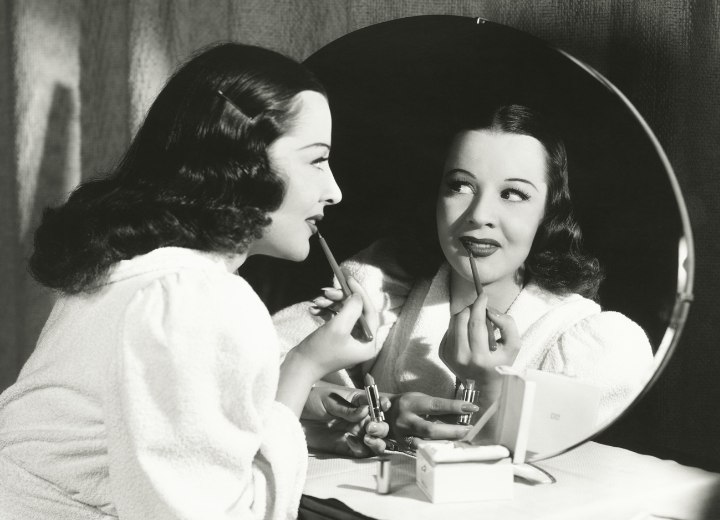
Their hairstyles were more modest, although; just as bedazzling as their hats during this time,
only in a different way. It was important for things to be organized during these troubled years and their hairstyles and dress
revealed this. Hair was washed with a simple shampoo with a thick styling agent applied and rolled with either clips, socks, scraps
of material or in the late 1940’s rollers (mostly clips) with a hairnet placed carefully over their head; as they sat under a very
large tube like hot dryer to dry. After taking the clips out a vigorous brushing would follow as the stylist would proceed to design
the hair in a style close to her head. There was a style that involved a very large roll placed for bangs, halfway on her forehead
and about an inch above her head. Her crown was flatly brushed down with a fluff of curls along the bottom and around the sides and
in the back. This style could work with almost any hat she selected to wear. Usually hair was worn shoulder length and there were
plenty of waves placed along with the styling. Straight parts were either on a side or in the middle. When there were middle parts
there were sometimes small to large rolls placed on each side off of the face with the hair flowing down into all one length with
the fluff of curls on the bottom.
Old time famous celebrity June Allison was known for wearing her hair in the famous pageboy style
of this time. She had naturally straight hair that was set to be curved with her straight forward bangs. We wouldn’t have recognized
her without this look. The pageboy had variations of straight and wavy and long or medium. Today we would put an undercut to this
style, but back then their hair was cut bluntly for the page boy and would go as high as the level as her eye or as low as laying
on her shoulders. Everyone rolled their hair under with rollers to have this smooth look. There were many up do’s to give feminine
appeal to their hats. Their hair would be brush up into tight small pinned curls to give room for this covering. Some bangs were
cut quite short, then many did not wear any, but wore their hair completely back in a no nonsense way. Most had their hair in one
complete level length. Some bangs were place in small curls to frame their face and eyes. Others had that large roll with the rest
of the hair pulled either back or up wearing a very large hat in the back.
Next Page
|
|
|