Hair Extenions, Put in with Glue
A: I always hesitate to make a judgement about someone else's hair service without as much information as possible (and preferably having the opportunity to visually inspect for myself). However, based on what you've said, it sounds as though there are a few possible causes for this problem.
Two: you haven't followed the care guidelines for the type of extensions you received closely enough.
Three: the quality of the adhesive wasn't what it should have been.
If you had the hair extensions put in in a salon (or by a professional in another setting) I recommend contacting the salon/stylist for assistance with this problem. In most cases, the salon/stylist is more than happy to help you resolve any problems with the service, because it only takes one unhappy client to deter many potential ones. They have a vested interest in making sure you are happy and that you look your best.
(Editorial Note: the following portion of this response is an attempt to answer the question to the best of my ability, with limited information available. I have limited experience in working with extensions, and have researched the subject to provide this response. I am in no way endorsing this as a course of action, and I assume no liability in providing these possible suggestions if any reader puts them into action. While I am a licensed Master Cosmetologist, working with some techniques of hair extension - specifically the fusion method - requires that the stylist has certification which I do not possess. Always seek a professional with the necessary certification for the procedure you need assistance with.)
If seeking out the stylist/salon isn't an option, you might consider the following to help with the problem:
Using cotton swabs and a hair oil (a shine product like Citre Shine spray laminator) gently dab the areas just below the bonds to coat them and keep the hairs from sticking together before bedtime. Use a new, soft-bristled toothbrush to gently brush out the hair and distribute the oil away from the bonds. IMPORTANT: DO NOT USE any oil or product with silicone or petroleum base for this purpose. They can dissolve the bonds, and the extensions can fall out.
If you are convinced that the problem is an excessive amount of adhesive, you might also try using rubbing alcohol on a cotton swab (load the alcohol on the swab by dipping the swab into the alcohol and botting it on dry paper towels until the swab is merely 'damp') to carefully remove the excess adhesive. NEVER apply the swab directly on the bonded area as the alcohol will break the adhesive bond.
It is IMPORTANT to note that the above suggestions should be used only as a last-ditch effort to resolve the issue and only if you cannot get the salon/stylist responsible for putting the extensions in (or another salon/style professional) to correct the problem, and you are personally willing to accept the risks involved.
Hair Extensions are a great way to add instant length to your hair and to combat classic hair problems, including an unfortunate haircut experience. It can also allow someone considering growing their hair long to see what it could look like and know whether it is truly something they want to do. Extensions can be applied with a weaving method, or by using adhesives.
The weaving method involves braiding horizontal tracks into the hair, to which wefts of hair are sewn. (A weft is a row of hair strands that are attached at a thin base.) The added tracks and wefts alternate with the natural length of the clients hair to add length. The client's own hair blends in with the wefts and gives an overall appearance of long-layered hair.
The adhesive methods come in two forms: the bonding method and the fusion method. The bonding method uses wefts of hair that are glued directly to the client's scalp using a special adhesive. This gives a result very like the weaving method, but is faster and usually less expensive.
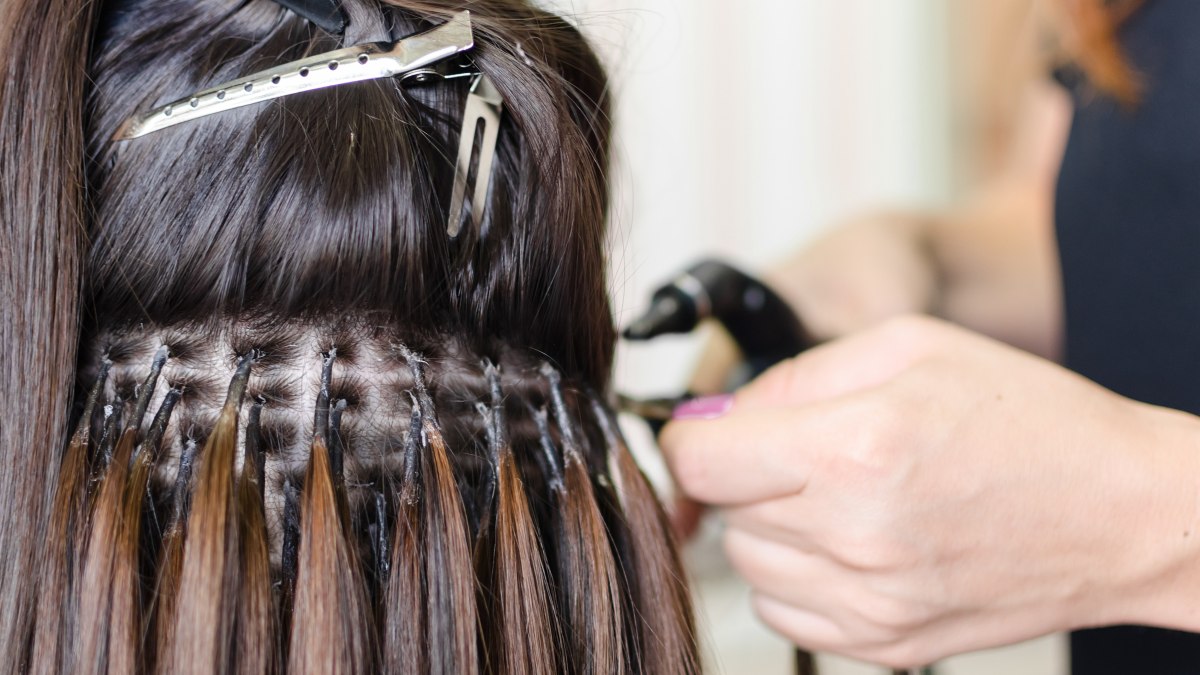
The fusion method is a process where hair extensions are bonded to the natural hair in small clusters, or even strand by strand in some cases. The process is by far the most expensive, but yields the most natural-looking results and lasts the longest (up to around 4 months).
Regardless of the methods used, the client should be prepared to return to the stylist/salon every two weeks for a check-up visit and for maintenance care. The client should also follow the hair care guidelines his/her stylist recommends, which can vary according to the type of extensions and the individual products used. Failure to do so can result in damage to the hair, diminished life of the style and poor results in the longer term.
©hairfinder.com