Haircutting Practice Heads Basics (2)
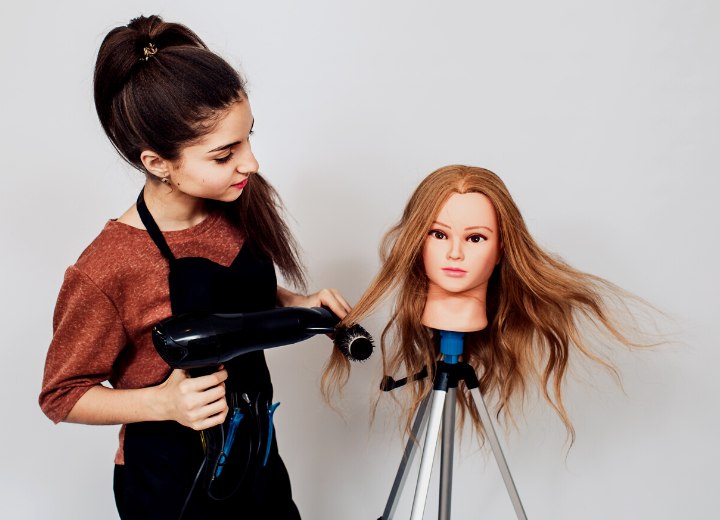
The standard-quality manikin is commonly a manikin type made from human hair that is processed for uniform texture, but which may also be processed for uniform color as well. These are great for haircutting and styling practice, as well as color practice (understanding that they may have already been colored), but not for practice with texture chemicals such as perm solutions.
Very often, the chemicals used to adjust the texture of manikin hair during the preparation of the manikin are incompatible with perm solutions and will result in serious damage to the hair. It could even result in the complete disintegration of the hair and the ruin of the manikin.
Typically on the lowest end of the "standard-quality" spectrum of manikins is the manikin made entirely of synthetic fibers. These manikins are generally only suited to use in haircutting practice. Some may be used with very low-heat styling techniques, but they cannot be used to practice with heated styling appliances, color services or perming and straightening, as they do not respond to chemical penetration and will easily melt under the extreme heat of styling tools.
Buying a Manikin or Cosmetology Mannequin
Practice heads are produced by many different beauty education supply companies. Some of the most prevalent makers and distributors include companies like Burmax, Celebrity, and Pivot Point. These companies offer manikins under specific "product names" which denote a specific look and hair type or length.
The name of the product is also an indicator of the manikin’s specific "face" creating an identity by which to indicate a specific manikin. The names can include Burmax’s "Whitney" (mid-length, ethnic type hair), "Debra" (mid-length, European type hair) or "Victoria" (longer length European type hair); or Celebrity’s "Dionne" (mid-length Afro type hair), "Erica" (mid-length Naturally curly type hair) or "Evan" (budget male human hair).
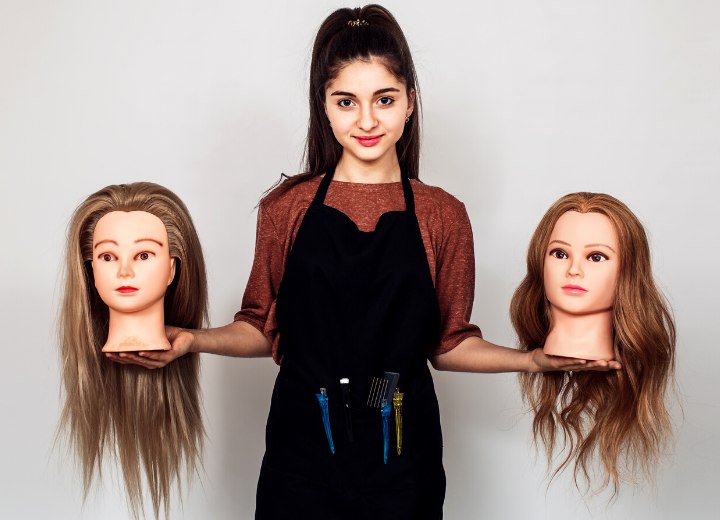
You need to be aware that you may pay more for less-common hair types and lengths, specifically since some types – like the naturally curly hair manikins – are made using virgin hair and cannot be created by chemical means. Longer hair manikins will definitely be at the higher end of pricing ranges given the length of time required to grow hair to certain lengths. If you want to get an idea of the time involved, remember that the average hair growth is around one-half inch (1.27 cm) per month and a manikin will require more than the listed length of hair in order to manufacture the head.
If you estimate an additional inch of hair to make the training head, a manikin with natural human hair that is 28 inches (71.12 cm) long would take a minimum of 58 months (without any hair trimming) which means nearly five years of time to grow the hair. This assumes that a single individual could grow enough individual hairs to make the manikin. Since the number of hairs per head varies with individuals, it could easily take multiple people to grow enough hairs for one manikin. These calculations are not industry-specific, but are generalizations used to illustrate the amount of time and effort that would be involved in producing a human hair mannequin.
For common hair types of standard quality, manikins usually average around $30 (USD) each. Longer manikins can range into the hundreds of dollars for human hair manikins, though haircutting manikins made from protein fibers can be found for less.
The key is to decide what you want from your manikin. If you need to practice cutting, then you can perhaps simply use a lower-quality manikin to get that practice and save some money. But if you need to work with color and perming chemicals, you want to make sure to choose a high-quality manikin that will allow for that. The options are out there, and with a little careful consideration, you can get the product you want, without having to break your budget.
©Hairfinder.com
See also: Cosmetology schools